Charleston
Can you run an Airbnb or do rental arbitrage here? What the city requires: permits, taxes, safety rules and enforcement.
Red light: residential permits need an owner who lives there
A residential permit goes only to an owner's full-time primary residence, verified by the county's 4% Legal Residence exemption.[1] Rentals in homes the owner doesn't live in need a commercial permit, which is limited to certain commercial districts in the Short Term Rental Overlay Zone.[2] The city describes that zone as a pre-existing area in Cannonborough-Elliotborough.[1]
Our verdict, based on the sources at the end of this guide.
A residential permit goes only to an owner's full-time primary residence, and the city checks it through the county's 4% Legal Residence exemption.[1] Commercial permits don't need the owner to live there, but they are limited to commercial districts in one overlay zone in Cannonborough-Elliotborough.[2, 9] The city is also weighing changes, including an eight-guest cap per unit.[10] The application review fee is $345, plus fire fees and a business license.[4]
Key requirements
Primary residence
A residential permit requires the property to be the owner's full-time primary residence, verified by the county's 4% Legal Residence tax exemption.[1] The city also checks through application requirements like drivers' licenses and through the business license process.[1] The zoning code says the record owner must live on the property and be there overnight while guests are present.[8]
Permit categories
Residential permits come in three location categories: Category 1 is the Old and Historic District on the peninsula, Category 2 is the rest of the peninsula outside the overlay zone and that district, and Category 3 is all areas of the city off the peninsula, including West Ashley, Johns Island, James Island and Daniel Island.[2] Categories 1 and 2 allow one STR unit per property, and all three categories need one off-street parking space.[2] Category 1 also needs a unit in a structure on the National Register of Historic Places, and Category 2 needs a building constructed 50 or more years ago.[2]
Commercial permit
Commercial short-term rentals are allowed in the CT, LB, GB, UC, MU-1, MU-1/WH, MU-2 and MU-2/WH districts within the Short Term Rental Overlay Zone, and they don't have to be the owner's primary residence.[2] The city calls the overlay a conditional use area for commercially zoned parcels in the Cannonborough-Elliotborough neighborhood.[9] A lot can hold no more than nine STR units.[2]
Application package
The city's checklist lists the application, the county assessor's 4% property tax verification, a Fire Marshal self-survey fire inspection and a smoke alarm test report.[5] Incomplete applications are denied, and you can't advertise or operate until all approvals and fees are done and a Certificate of Operation is issued.[5]
License and renewal
Every short-term rental needs a city business license and a permit.[6] Permits renew every year by the original date of issuance, and the license number must be posted in the unit and in all ads.[5, 6]
Operational and safety standards
Guest limit
The zoning code allows stays of 1 to 29 consecutive days by up to four adults, and the city's FAQ says the four can be unrelated.[8, 1] The commercial application caps each unit at four unrelated people, with one family at a time.[3]
Parking
Provide at least one more off-street parking space for the STR unit, on top of the spaces the main residential use already needs.[1]
Host and contact
The city's 2021 FAQ says the host doesn't have to be present for the whole stay, but the code says the owner must be on site overnight while guests are present, so plan for the code.[1, 8] The commercial application requires the owner, operator or emergency contact to be reachable by phone 24 hours a day, 7 days a week.[3]
Guest rules and inspections
Commercial units may serve no meals other than breakfast, must keep a guest register with names, addresses and occupancy dates, and can face annual city inspections.[3] Commercial STRs can have no exterior signs and no common areas for renters, such as breakfast rooms.[2]
If you are a tenant
A tenant can't hold the residential permit, since it needs the owner's primary residence.[1] What you can do instead is manage for an owner who holds the permit, under a written agreement, and the commercial application lists an owner and an operator who both sign.[3] South Carolina law defines a property manager as someone who, for compensation, negotiates or lists rentals or provides a service in connection with leasing them, and it is unlawful to act as one without a license.[11]
Tax obligations
Rates by county
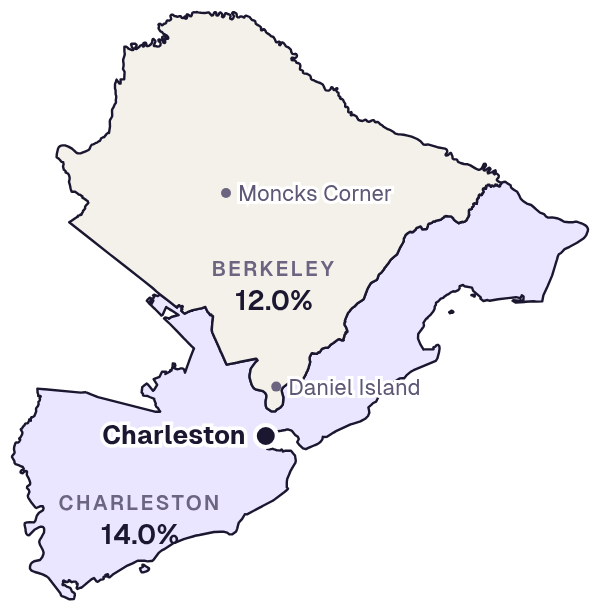
Inside the city in Charleston County, the total is 14.0%: 5.0% state sales, 2.0% state accommodations, 1.0% local option sales, 1.0% county transportation, 1.0% school district, 2.0% Charleston County accommodations and 2.0% city accommodations.[6] For properties in Berkeley County, the total is 12.0%, because the Charleston County accommodations tax doesn't apply.[6]
State tax
The state charges 5% sales tax and 2% accommodations tax, plus any local taxes, on rentals of less than 90 continuous days.[12] Returns are due by the 20th of the month after the filing period.[12]
Who collects
The state says the person or business who books the accommodations collects and pays the tax, so an online travel company or property manager handles it if you use one, and otherwise you do.[12] The city warns that not every online marketplace collects the local accommodations tax for you.[6]
Pending tax bill
House bill 3876 would have platforms collect the tax unless a property management company is named merchant of record.[13] Its last action on the bill page was a favorable committee report with an amendment from Senate Finance on May 5, 2026, and the page shows no Act number.[13]
Enforcement
Revocation
The city's FAQ says three findings of guilt by the Livability Court will result in revocation of the STR permit.[1]
Tax penalty
State law allows a civil penalty of not less than $500 and not more than $2,000 for each seven days the property was rented if you don't collect and remit the local accommodations tax.[6]
Proposed city changes
The city's Oct 22, 2025 Planning Commission item proposed a limit of two adults per bedroom with a maximum of four unrelated adults per unit, seven-day cure periods, and automatic revocation after four violations in 12 months.[14] By July 15, 2026, the proposal had an eight-guest cap per unit, limits on advertising occupancy and a five-year suspension for exterior modifications.[10] That meeting drew 27 public comments, 23 of them opposed.[10]
Where it stands
A news report says the commission unanimously voted against advancing the proposal to City Council on July 15, 2026, and that it had deferred the amendments the fall before.[15] The city's April 15, 2026 agenda lists the item as deferred.[16]
State bills
House bill 3861 would bar local bans on short-term rentals, and its last action was Jan 30, 2025.[17] Senate bill 442 would let local governments regulate or prohibit them, and its last action was Mar 19, 2025.[18]
Bottom line for arbitrage
Skip Charleston unless a landlord owns a commercially zoned parcel in the overlay zone. Everywhere else, the permit needs an owner who lives there.
Step 1 is the hard part. We find landlords who already said yes →
Sources
Tell us your market. Our team calls landlords and sends you properties already approved for Airbnb.
- Landlord-approved listings
- New deals weekly
- Search any US market
More guides in this state
Browse all city guides →Rules tell you where. We find the landlord who says yes.
STR Exchange members get landlord-approved rentals, new deals every week and a team that searches their market.
- Landlord-approved listings
- New deals weekly
- Many markets