Fort Lauderdale
Can you run an Airbnb or do rental arbitrage here? What the city requires: permits, taxes, safety rules and enforcement.
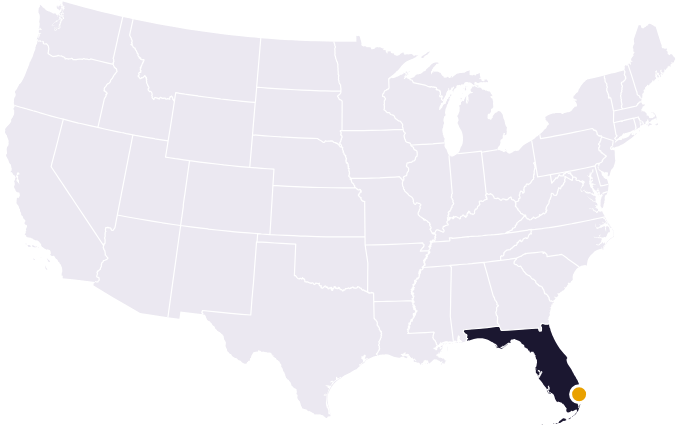
Yellow light: allowed with annual registration, but the rules and fines are heavy
Florida law bars local bans on vacation rentals and local rules on how long or how often you rent, except rules adopted on or before June 1, 2011.[1] Fort Lauderdale still requires a Certificate of Compliance, which costs $880 to register and $650 a year to renew for a rental the owner doesn't live in.[2, 3] Running without a valid certificate carries a $1,000 civil penalty for each day.[4]
Our verdict, based on the sources at the end of this guide.
Florida law bars local bans on vacation rentals and local rules on how long or how often you rent, with an exception for rules adopted on or before June 1, 2011.[1] Fort Lauderdale still runs a registration program for one- to four-family homes and condos advertised for 30 days or less.[8] You need state and county licenses first,[2] a noise monitor and an annual inspection.[4] The city approved a $1,000 per day penalty for operating without a valid certificate in September 2026.[4, 8]
Key requirements
State and county licenses first
Before you apply to the city, get a state DBPR vacation rental license, a Florida Department of Revenue registration, a Broward County business tax receipt and a Broward County tourist tax registration.[2] The state license costs $50 to apply, a $10 education fee and $170 a year for a single unit.[9, 10]
City registration
Apply online through LauderBuild for a Certificate of Compliance.[2] It costs $880 for up to 4 units under one folio and includes the first inspection.[2] Processing is about five business days after acceptance, and the city warns of 10 to 12 business days in August and September.[2, 8]
Who can apply
Owners, business entities or authorized agents can register, and anyone who isn't the owner needs a notarized letter of authorization from the owner or managing member.[2] You also send a sample guest lease, proof of ownership and a sketch or photo of off-street parking with the line "No on-street parking permitted".[2]
Covered homes
The program covers single-family, two-, three- and four-family homes and condos advertised for 30 days or less, but not timeshares.[8] Accessory dwellings in RS-8 and RD-15 zones can't be used as vacation rentals.[3]
Annual renewal
Certificates expire Sept 30, and the renewal application is due at least 60 days before, which the city lists as Aug 1.[3, 4] Renewal is $650 for a rental the owner doesn't live in and $200 for an owner-occupied, homestead-exempt one.[3] If you miss Sept 30, the city processes it as a new application at $880 with a new inspection.[3]
Operational and safety standards
Occupancy
The limit is 2 persons per legal bedroom.[2] The ordinance also caps a gathering at 20 persons, with an exception for some owner-occupied rentals.[4]
Noise monitor and quiet hours
Install a noise level detection device that alerts you and your guests, keep its data for 180 days and give it to the city on request.[4] Sound can't be plainly audible for one minute or longer at 25 feet between 10:00 p.m. and 7:00 a.m.[4]
Responsible party
Name a responsible party who can respond in person within one hour of being notified.[4] The contact's phone must be answered 24 hours a day, 7 days a week.[4]
Inspections and safety
The unit is inspected before the certificate is issued and again every year, and violations must be fixed and re-inspected within 30 calendar days or the certificate can be suspended.[4] Smoke alarms must be hard-wired, and pools must meet the Residential Swimming Pool Safety Act, Chapter 515.[4]
Parking and trash
Vehicles must park in a driveway on the property.[4] Trash can't go to the curb before 6:00 p.m. the day before pickup.[4]
Tax obligations
State sales tax
Florida charges 6% state sales tax, plus any local surtax, on stays of six months or less.[5] Register with the state to collect and remit it; returns are due on the 1st and late after the 20th.[5]
Broward taxes
Broward County adds a 1% discretionary sales surtax.[6] It also has a 6% tourist development tax, collected by the county.[7]
Tourist tax filing
Broward tourist tax returns are due on the 1st and late after the 20th, and the minimum penalty for a late return is $50.[11] The county's filing instructions we read date from 2018, so check the current rules.[11]
City business tax
The city business tax receipt is invoiced separately from the vacation rental fee and renews at $157.50 a year.[3] A $100 late fee applies if the renewal is late or incomplete after the Aug 1 deadline.[3]
Booking platforms
The state says anyone who receives rent on behalf of the owner must also register to collect tax.[5] We could not confirm whether booking sites collect Broward's tourist tax, so check each site and keep your own accounts.
Enforcement
No valid certificate
Operating without a valid certificate, including an expired one, is a $1,000 civil penalty for each day, unless renewal is delayed solely by city administrative action.[4] The ordinance passed first reading on Aug 18, 2026 and takes effect 30 days after adoption, and the city's notice gives Sept 15, 2026 as the approval date.[4, 12]
Suspensions
A third violation brings a 180-day suspension and a fourth a 365-day suspension.[4] Operating during a suspension costs $1,000 a day, or $5,000 a day for a repeat, and up to $15,000 per violation if a magistrate finds it irreparable.[4]
Citations
Other violations cost $250 if uncontested and $325 if contested, after a 2023 amendment.[8]
Complaints
Neighbors can report problems to a 24/7 hotline at 1-800-685-7453, through FixIt FTL or by email.[13] The city publishes lists of registered properties and open cases.[13]
State law
A local law may not prohibit vacation rentals or regulate how long or how often you rent them, but this does not apply to rules adopted on or before June 1, 2011.[1] A 2026 water safety bill for rentals, CS/CS/SB 658, died in the House on Mar 13, 2026.[14]
Bottom line for arbitrage
Workable if you budget for the fees, the noise monitor and the $1,000-a-day risk. Get the owner's notarized letter before you start.
Step 1 is the hard part. We find landlords who already said yes →
Sources
Tell us your market. Our team calls landlords and sends you properties already approved for Airbnb.
- Landlord-approved listings
- New deals weekly
- Search any US market
More guides in this state
Browse all city guides →Rules tell you where. We find the landlord who says yes.
STR Exchange members get landlord-approved rentals, new deals every week and a team that searches their market.
- Landlord-approved listings
- New deals weekly
- Many markets