Long Beach
Can you run an Airbnb or do rental arbitrage here? What the city requires: permits, taxes, safety rules and enforcement.
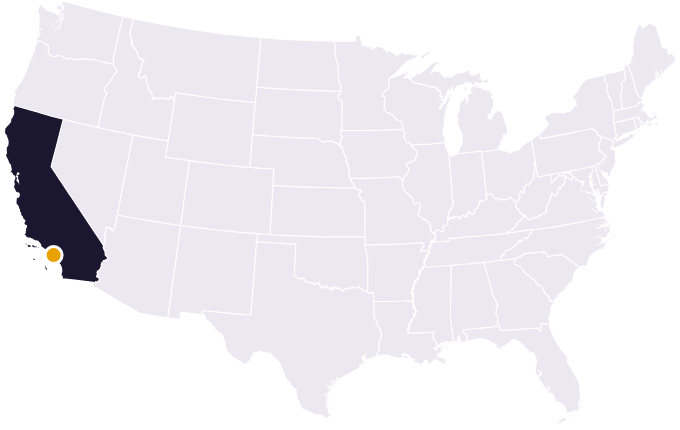
Yellow light: allowed with a city registration, but non-primary units are capped at 800
Long Beach allows rentals you don't live in, but non-primary registrations are capped at 800 citywide and each operator can hold only one.[1] Applying costs a $500 review fee,[2] and a tenant needs the owner's notarized consent.[1] The 90-day yearly limit on un-hosted stays is written for primary-residence STRs.[3]
Our verdict, based on the sources at the end of this guide.
Long Beach allows short-term rentals through a city registration with two tracks. A primary-residence STR is your own home, and un-hosted stays there are limited to 90 days per registration year.[3, 6] A non-primary STR, the track for a tenant who lives elsewhere, is capped at 800 citywide, one per operator.[1] The city charges a $500 review fee,[2] taxes guests 13%,[4] and says it is reviewing the ordinance for possible updates.[2]
Key requirements
Two registration types
A primary-residence STR is your permanent home, where you live at least 275 days a year, shown with at least two documents such as a driver's license or a recent utility bill.[6] Any other STR is a non-primary STR.[6]
Cap and per-operator limit
Non-primary registrations can't exceed 800 dwelling units citywide unless the City Council changes it, and the coastal zone has its own cap of 350.[1] An operator can run one primary-residence STR and one non-primary STR in the city.[1] A residential development of 2 to 10 units can have 1 STR, and larger ones are limited to 10% of units at 11 to 50, 12% at 51 to 100 and 15% at 101 or more.[1]
Tenant and landlord
A tenant can be the operator, but the application needs a signed, notarized owner consent form, and a property manager can file it with a current management agreement.[1] Landlords and associations can put a building on the prohibited buildings list, and a unit on it can't register.[1, 2] Registration doesn't override a non-discriminatory HOA rule or covenant that restricts STRs, though in the coastal zone that covers only ones recorded before Jan 1, 1977.[1]
Eligible units
ADUs, junior ADUs, deed-restricted affordable units, special group residences and single room occupancy units can't register.[1] STR use is also barred in garages, pool houses, casitas, sheds, vehicles and any space not approved as habitable.[3]
Application and inspection
You pay the $500 review fee before the city reviews your application, and it isn't refundable once reviewed.[2] The city inspects the unit, you must fix any hazards before registration, and you have 45 days after review to finish or the application becomes invalid.[1]
Renewal and transfer
A registration lasts one year, can't be transferred and doesn't run with the land.[7] Once non-primary registrations reach the 800 cap, a renewal filed less than 30 days before expiration makes the registration null and void.[7]
Operational and safety standards
Listing rules
Every ad, including platform listings, must show the city registration number and expiration date.[3] Don't advertise any room the inspection didn't document, and put no sign on the outside of the property.[3]
Occupancy and events
The limit is two people per bedroom plus two, up to 8, including children, and 2 for a studio.[3] Large events such as weddings and fundraisers are banned unless you hold an occasional event permit, and you can get at most four per registration year.[3]
Emergency contact
Name a contact who is reachable 24/7 and can respond within one hour to a complaint the city forwards.[1] Post a notice in the unit with the occupancy limit, parking rules, trash pickup, the contact's phone number and an evacuation plan.[3]
Insurance and safety
Carry at least $1,000,000 in liability insurance, or book only through a platform that provides equal or greater coverage.[8] Keep working fire extinguishers, smoke detectors and carbon monoxide detectors.[8]
House rules
Outdoor pools, spas and hot tubs are off limits from 10:00 p.m. to 7:00 a.m., and city noise and trash rules apply to your guests.[3] You and the property owner are jointly responsible for nuisance violations,[8] and you can't knowingly book anyone banned from an STR in the previous five years.[3]
Tax obligations
Transient occupancy tax
Guests pay a 6% tax plus a 7% general-purpose tax on the rent, which the city's tax page puts at 13%.[4, 5] The code requires the tax on all short-term rentals.[8]
Who collects
If a platform doesn't collect payment for the rental, you must collect the tax and send it to the city.[8] If the platform does collect payment, the platform and you share legal responsibility for collecting and remitting it.[8]
Filing and records
Returns and payments are due on the tenth of each month for the month before, and a late payment adds a 25% penalty, then 50% after 30 more days, plus 1% a month after 60 days.[5] The city says operators report and pay through the same online portal used for registration, and renewal requires your records for the past year.[2, 7]
State law
California's SB 346, approved Oct 13, 2025, lets a city that adopts an ordinance require platforms to report each rental's address and to show the local license number on listings.[9] It doesn't stop a city from regulating differently.[9]
Enforcement
Fines
Each violation carries a $1,000 fine, and one event or continuing violations can bring several citations.[10] Citations may be issued right away, without a cure period, and you must agree to get city notices and fines by U.S. mail.[8, 10]
Three-citation rule
Three citations within 18 months can lead to revocation, suspension, disallowance or added conditions, after 14 days' notice to respond.[10] If a registration is revoked or disallowed, no unit on that parcel can register for at least 12 months.[10] The city also won't renew a registration after three or more citations in a contiguous 18-month period.[7]
Complaints and platforms
The city runs a 24/7 hotline at 562.568.8665 that relays complaints to the registered emergency contact.[2] Platforms must remove listings when the city notifies them and send the city monthly listing and booking data.[11]
Neighborhood petitions
Owners in a census tract block group can petition to prohibit un-hosted STRs there, and an approved restriction lasts at least three years.[12] Petition periods run from January 1 through June 30 each year.[12]
2025 to 2026 changes
The City Council rewrote the chapter in 2025 (ORD-25-0001), and a 2026 code enforcement ordinance, ORD-26-0004, amended the operator-requirements and petition sections.[1, 8, 12] The city says it is reviewing the ordinance for possible updates and that existing law bars evicting tenants to re-list a unit as an STR.[2]
Bottom line for arbitrage
Workable if you land a non-primary slot and your landlord signs. Treat the 800 cap and the one-per-operator limit as your ceiling.
Step 1 is the hard part. We find landlords who already said yes →
Sources
Tell us your market. Our team calls landlords and sends you properties already approved for Airbnb.
- Landlord-approved listings
- New deals weekly
- Search any US market
More guides in this state
Browse all city guides →Rules tell you where. We find the landlord who says yes.
STR Exchange members get landlord-approved rentals, new deals every week and a team that searches their market.
- Landlord-approved listings
- New deals weekly
- Many markets