Phoenix
Can you run an Airbnb or do rental arbitrage here? What the city requires: permits, taxes, safety rules and enforcement.
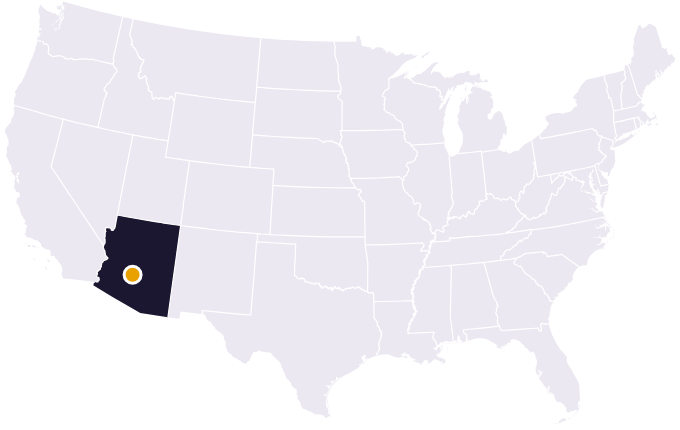
Yellow light: allowed with a permit, but expect strict rules and fines
Arizona law bars Phoenix from banning short-term rentals, or regulating them by use or occupancy,[1] so you can scale here. But every unit needs its own $250 city permit,[2, 3] and violations carry fines that climb to $3,500 or three nights' rent.[2]
Our verdict, based on the sources at the end of this guide.
Arizona law bars Phoenix from banning short-term rentals or regulating them by use or occupancy,[1] so the city runs a permit program instead.[2] You need a $250 city permit for every unit,[2, 3] plus a state TPT license and a Maricopa County rental registration.[3] If the property has an ADU approved on or after September 14, 2024, the owner must live on the property.[1, 2] Violations bring tiered fines and permit suspensions of up to 12 months.[2, 3]
Key requirements
City permit
Get a city permit before you rent or offer to rent a short-term rental.[3] It costs a non-refundable $250 for a new permit and for each renewal, and it expires one year after it's issued.[2, 3] The city must approve or deny a complete application within seven days, and you should file renewals at least 15 working days before the permit expires.[3]
Who applies and per-unit rule
The code defines an owner as anyone with title, a lease or another interest in the property, with or without possession.[3] You file a separate application for each dwelling unit in a single-family or one- to four-family property and for each unit in a condominium or cooperative.[3] The application asks for the owner's details and, if there is one, the owner's designee.[3]
Application papers
Send proof of a valid state TPT license, at least $500,000 in liability coverage or a platform that gives equal coverage, and your county rental registration.[3] The city's affidavit has you confirm you're lawfully present in the US, that no permit for the property is suspended and that you'll renew every 12 months.[6] The state says you can't offer a rental without a TPT license, and the county Assessor says rental property must be registered with it.[7, 8]
Neighbor notice
Send a Notice of Intent by certified mail to neighboring properties and to registered HOAs and neighborhood associations within 600 feet.[2] Neighbors are single-family homes next to, across from or diagonally across from the property, or every unit on your floor in a multifamily building.[3] The notice lists the address, permit number and emergency contact, and you file proof of mailing and an attestation of compliance with the city before you operate.[3]
ADU owner rule
If the property has an accessory dwelling unit (ADU) with a certificate of occupancy issued on or after September 14, 2024, the owner must live on the same property.[1, 2] Since April 4, 2026, the application needs a notarized attestation that the owner will reside there, plus proof of address.[2] The state rule doesn't apply to an ADU whose certificate was issued on or before September 13, 2024.[1]
Operational and safety standards
Listing and signage
Show your permit number on every advertisement, along with a notice that the owner, renter and guest may be liable for up to $2,000 in police response costs.[3] Post a copy of the permit inside, clearly visible within ten feet of the primary entrance.[3] The state also requires your TPT license number on any ad.[9]
Emergency contact
Your emergency contact must be on the premises, or reachable by phone or text, within 30 minutes of a request from police, fire or code enforcement.[3] After one verified violation in 12 months, or a permit suspension in the past 36 months, the contact must be there in person within 30 minutes.[3] Tell the city right away if the contact changes, and post the owner, designee and contact details within ten feet of the entrance.[3]
Safety
Keep a working smoke and carbon monoxide detection and notification system that meets NFPA 72, plus a portable fire extinguisher in the kitchen and any area with an open fire source such as a stove, fireplace or grill.[3] The affidavit also has you confirm the address meets pool barrier rules and the Phoenix Building Construction Code.[6] The code lets Neighborhood Services adopt a policy to inspect rentals regularly.[3]
Guest checks
Run a registered sex offender background check on each guest, keep proof for 12 months and show it to code enforcement on request.[3] You can't rent to a registered sex offender.[3] State law waives the city's check if a booking platform runs one.[1]
Prohibited uses
A rental can't be used for a non-residential use, a special event that needs a permit or license, a retail business, a restaurant, a banquet hall or an event center.[3] The code also bars knowingly housing registered sex offenders, running a sober living home, selling liquor, illegal drugs or pornography, and adult-oriented businesses.[3] State law bars non-residential uses too.[1]
Tax obligations
State and county tax
Short-term rentals of less than 30 days are taxed as transient lodging under the state's transaction privilege tax (TPT).[9] The state's October 2026 rate table lists 7.27% for transient lodging in Maricopa County.[4] Phoenix's chart splits that into 5.5% state and 1.77% county.[5]
City tax
The city's July 2025 chart lists 2.8% plus 3.0% for transient lodging of 29 consecutive days or less, a 5.80% city rate.[5] With the state and county rate, that's 13.07% in total.[4, 5]
Who collects
Booking sites must register with the state and pay the tax on bookings made through them.[7] You still need your own TPT license, and if you book only through a platform you must file a return that deducts those receipts.[7] Direct bookings aren't deducted and you owe that tax yourself, and you file a $0 return for any period with no rentals.[9]
Stays of 30 days or more
The state calls renting real property for more than 29 days for residential purposes a residential rental, not a short-term rental.[9] Phoenix's chart has a separate non-transient line for lodging of more than 29 consecutive days, at 2.80% with no state or county tax.[5]
Enforcement
No permit
Renting or offering to rent a short-term rental without a permit is prohibited, and so is knowingly staying in one that has no current permit.[3] The code sets a penalty of $1,000 per month for operating without a permit, and the court dismisses it if you get a permit within 30 days after the complaint.[3] State law also lets a city add up to $1,000 a month once a written notice to apply goes unanswered for 30 days.[1]
Fines for violations
The city's page lists fines for court-adjudicated violations as a minimum of $500 or one night's rent for a first violation, $1,000 or two nights' rent for a second and $3,500 or three nights' rent for a third.[2] State law words the same tiers as up to those amounts, whichever is greater, for verified violations in a 12-month period.[1]
Suspension and appeal
The city can suspend a permit for up to 12 months after three verified violations in 12 months, or after one serious violation such as a felony at the property, knowingly housing a sex offender or allowing a special event.[3] Aesthetic, trash and parking violations don't count unless they're a serious threat to health and safety.[3] You can appeal a denial or suspension to the hearing officer within 21 days of the decision, or within 28 days of filing a new or renewal application, whichever is longer.[3]
Complaints
The Neighborhood Services Department leads enforcement through code compliance and investigates rentals without permits.[2] If you gave the city your contact details, it must make a reasonable attempt to tell you within seven business days after it issues a citation.[1]
2026 state bill
The House version of HB 2429 would let cities cap overnight occupancy, count violations over 24 months instead of 12 and deny permits for unpaid fines.[10] A May 1, 2026 news report says it passed the House 37 to 14 but got no Senate hearing, so it didn't become law.[11]
Bottom line for arbitrage
You can scale here, but check the property for a newer ADU first. Budget for a $250 permit on every unit and strict enforcement.
Step 1 is the hard part. We find landlords who already said yes →
Sources
Tell us your market. Our team calls landlords and sends you properties already approved for Airbnb.
- Landlord-approved listings
- New deals weekly
- Search any US market
More guides in this state
Browse all city guides →Rules tell you where. We find the landlord who says yes.
STR Exchange members get landlord-approved rentals, new deals every week and a team that searches their market.
- Landlord-approved listings
- New deals weekly
- Many markets