San Antonio
Can you run an Airbnb or do rental arbitrage here? What the city requires: permits, taxes, safety rules and enforcement.
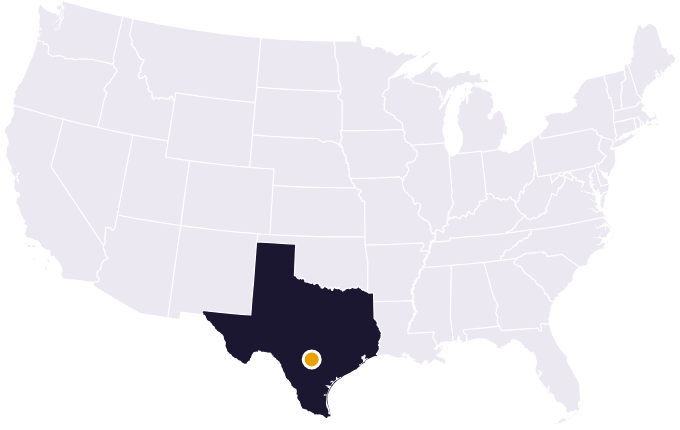
Yellow light: allowed, but capped at 12.5% of units per block face
San Antonio allows rentals you don't live in with a Type 2 permit, but limits them to 12.5% of the units on a block face, with at least one allowed per block face.[1, 2] Above that limit you need a special exception from the Board of Adjustment.[3] A Type 2 permit costs $1,000 plus an 8% surcharge,[1] and a violation can mean fines of up to $500 a day.[4]
Our verdict, based on the sources at the end of this guide.
San Antonio allows rentals you don't live in, called Type 2, but limits them to 12.5% of the units on a block face and always allows at least one.[2] Above the limit you need a special exception from the Board of Adjustment,[3] and the city's FY 2025 report shows a 25% approval rate across 87 cases.[7] A Type 2 permit costs $1,000 plus an 8% surcharge,[1] and 77% of the city's active permits are Type 2.[7]
Key requirements
Type 2 permit
Apply for a Type 2 permit for any rental the owner or operator doesn't live in.[1] It costs $1,000 plus an 8% surcharge, and the fee is non-refundable.[1, 8] Each unit needs its own permit, which lasts three years and is issued within five business days of a complete application.[1]
Owner authorization
If you aren't the owner, your application needs a notarized authorization from the owner.[1, 9] The code says a tenant may serve as operator when the owner expressly permits it in writing.[4] A permit can't be transferred to another owner, unit or location.[4]
Block-face limit
Type 2 rentals are limited to 12.5% of the single-family, duplex, triplex and four-plex units on a block face, with no rounding up, and at least one is allowed per block face.[2] A block face is one side of the street between intersections,[1] and a corner lot counts as one block face, set by the street in the unit's address.[4] In a building with 5 to 7 units one Type 2 is allowed, and with 8 or more units the limit is 12.5% of the units.[2]
Special exception
Over the limit, you need a special exception from the Board of Adjustment, which costs $460 for a property with a homestead exemption and $690 for all others, plus an 8% surcharge.[1] The board can grant it for up to three years, and only after notice and a hearing.[3] The city's FY 2025 report counts 87 cases and a 25% approval rate, and notes the chart includes withdrawn cases.[7]
Zoning
The city's fact sheet says rentals are allowed in any residential zoning district, and in districts with established residential use, except C-3, L, I-1 and I-2.[8] Check the property on the city's One Stop zoning map.[1]
Application and renewal
You need contact details for the owner, the applicant and a 24/7 designated operator, a floor plan, a parking plan and proof of ownership.[1] The application also includes a sworn self-certification of compliance, including insurance and annual independent inspections of required fire extinguishers.[4] Renewal costs the same, and the city checks that your hotel occupancy tax account is current.[1]
Operational and safety standards
Listing rules
Put your permit number in the description or body of every ad, including on a website or app.[4] The city asks the platform to remove a listing that lacks a valid permit number, and the platform must remove it within 10 business days.[4]
Occupancy and parking
Your permit sets a maximum number of guests, which follows the San Antonio Property Maintenance Code.[4] Parking must meet the Unified Development Code, and required parking can't be in the public right-of-way, an access easement or the yard.[4] If you can't provide at least one off-street space, you can ask the Board of Adjustment for a parking adjustment.[4]
Fire and life safety
Mount a 2A:10B:C fire extinguisher within 75 feet of all parts of the rental on each floor, and install smoke and carbon monoxide detectors.[4] Every sleeping area needs an operable emergency escape opening, and an evacuation plan must be posted in each unit.[4] A bedroom that doesn't comply can't be used for sleeping or counted in the occupancy limit.[4]
Quiet hours and conduct
Quiet hours are 10 PM to 6 AM Sunday through Thursday and 11 PM to 6 AM Friday and Saturday, and you must post a notice of them where the rental has outdoor amenities.[4] Short-term rentals in residential zones can't be venues for weddings, events or restaurants.[2] You can't provide prepared food or drink for a fee, but prepackaged food or drinks are allowed.[2]
Contact, insurance and notices
Name a 24/7 contact who is responsible for answering complaints.[4] If a city official cites the property, that contact must try to reach the guests within one hour.[4] Keep an insurance policy sufficient for guests' personal injury liability, and post your permit and hotel tax registration inside the rental with the other required notices.[4]
Tax obligations
State hotel tax
Texas treats a short-term rental as a hotel for the state's 6% hotel occupancy tax.[10] The Comptroller says the tax applies to houses, and people who lease their houses must collect it from their customers.[11]
City and county tax
The city's hotel occupancy tax is 9%, made up of a 7% general tax and 2% for the Convention Center expansion, and the city also collects 1.75% for Bexar County.[6] Short-term rentals must report and pay online by the last day of the month after each reporting period, even with zero revenue.[6, 12] File your first report by the last day of the month you get your account number, without waiting for the permit.[12]
Booking platforms
Airbnb and Vrbo remit hotel tax directly to the state, and since Mar 10, 2025 they also pay the city's tax on your behalf.[12] You still file monthly city reports, pay Bexar County's tax through the city's portal and pay any tax the platforms didn't collect.[12] For a rental not booked through Airbnb or Vrbo, you report and pay city and county tax to the city every month.[12]
30-day stays
The city and Bexar County exempt permanent residents who have occupied or paid for a room for at least 30 consecutive days.[6] The state's exception covers a right to use a room for at least 30 consecutive days with no interruption of payment.[10]
Outside city limits
The city's rules apply only to properties inside San Antonio city limits.[8] A rental outside the city but inside Bexar County must still report and remit Bexar County hotel tax to the city.[4]
Enforcement
Fines
Owning or operating a rental without a valid permit is an offense.[4] A violation of the article can bring a fine of $200 to $500 per violation, per day, and each day a unit is occupied in violation counts separately.[4] It's also a Class C misdemeanor with a fine of $100 to $500.[4]
Complaints and inspections
After a report, the city inspects within three days, issues a 14-day notice for a violation and cites the property if it isn't fixed at reinspection, for up to $500 per day.[13] It can also inspect whenever a violation is reported or suspected.[4] If you're still in violation, staff will email the platform to remove the listing until you comply.[8]
Revocation
The city revokes a permit after three or more citations accepted by municipal court on three separate occasions in a rolling three-year period, whether they went to you or your guests.[4] Hotel tax not paid within 90 days of a delinquency notice also leads to revocation.[4] After a revocation, you can't reapply for the same property for 12 months.[4]
Appeals and meetings
You have 20 calendar days to file a written appeal of a denial, suspension or revocation, and the Board of Adjustment hears it.[4] After numerous or habitual complaints, the director may require a compliance meeting, and refusing to attend may lead to revocation.[4]
State law
Texas HB 2464, signed June 12, 2025, adds Local Government Code 229.902 on home-based businesses.[14, 15] That section says it doesn't prohibit a city from adopting or enforcing an ordinance regulating the operation of a short-term rental unit.[14]
Bottom line for arbitrage
Workable if your block face has room. Count the Type 2 rentals on it before you sign.
Step 1 is the hard part. We find landlords who already said yes →
Sources
Tell us your market. Our team calls landlords and sends you properties already approved for Airbnb.
- Landlord-approved listings
- New deals weekly
- Search any US market
More guides in this state
Browse all city guides →Rules tell you where. We find the landlord who says yes.
STR Exchange members get landlord-approved rentals, new deals every week and a team that searches their market.
- Landlord-approved listings
- New deals weekly
- Many markets