Miami-Dade County
Can you run an Airbnb or do rental arbitrage here? What the city requires: permits, taxes, safety rules and enforcement.
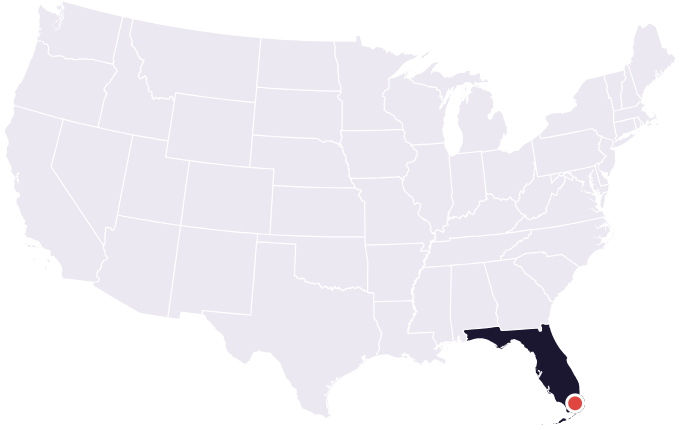
Red light: host must live in the home in Estate and Low Density areas
This guide covers homes in unincorporated Miami-Dade County, outside every city's limits; a Miami mailing address does not mean the home is in the City of Miami, and each city has its own rules.[1, 2] In areas the county's land use plan (the CDMP) marks Estate or Low Density residential, a vacation rental must be a home where the responsible party lives more than six months per calendar year.[1, 13] Every vacation rental also needs a county Certificate of Use, renewed every year.[1]
Our verdict, based on the sources at the end of this guide.
Miami-Dade County's vacation rental rules in Sec. 33-28 apply in the unincorporated areas of the county, and the county sends homes inside a city to that city for its rules.[1, 2] No one may offer a home there as a vacation rental without a county Certificate of Use, which is renewed every year.[1] The responsible party, the person the owner authorizes to get the certificate, can be the owner or someone else with the owner's permission.[1] In areas marked Estate or Low Density residential on the county's land use plan (the CDMP), the responsible party must live in the home more than six months per calendar year.[1, 13] That residency rule does not apply in areas marked Low-Medium, Medium, Medium-High or High Density residential.[1]
Key requirements
Outside city limits only
Sec. 33-28 applies in the unincorporated areas of Miami-Dade County.[1] Many homes with a Miami mailing address sit in the unincorporated county, in places such as Kendall, Westchester and Tamiami, and not in the City of Miami. For a property inside a municipality, such as Miami, Miami Beach or Doral, the county tells the owner or responsible party to contact that city for its regulations.[2]
What counts as a vacation rental
A vacation rental is any dwelling unit or residence, including a unit in a condominium, cooperative or apartment building, rented in whole or in part to a transient occupant for less than 30 days or one calendar month, whichever is less.[1] A home advertised or held out to the public as a place that may be rented that way counts too.[1] Hotels, motels and bed and breakfasts are not vacation rentals under this section.[1]
Residency rule in Estate and Low Density areas
In any area designated Estate or Low Density residential on the CDMP, the property must be a residence in which the responsible party resides for more than six months per calendar year.[1, 13] The home can be rented while the responsible party is living there.[1] So in those areas a home where the responsible party does not live more than six months of the year can't be a vacation rental.[1]
The residency rule does not apply to a vacation rental in an area designated Low-Medium, Medium, Medium-High or High Density residential on the CDMP.[1] The county's page says the rule applies to properties designated Estate or Low Density Residential on the CDMP Land Use Plan Map only, and that there are no residency restrictions in the other land use categories.[2] That page links the map, which is where you look up a property's designation.[2]
Certificate of Use
No property owner or responsible party may offer a property as a vacation rental, or let anyone rent or occupy it as one, unless a Certificate of Use has first been obtained.[1] The code says a property may be offered once the application is submitted, unless and until the application is rejected or revoked for failing inspection.[1] The county's page says responsible parties must obtain the certificate before listing and advertising the property on any platform.[2]
The certificate is renewed every year, and it can't be renewed while there are outstanding fines or liens for code violations.[1] The county's page says a new certificate must be obtained annually, and that you may apply on or before the day the current one expires.[2]
Who holds the certificate
The responsible party is the person or entity the property owner authorizes to obtain the Certificate of Use.[1] That party is responsible for compliance with all the vacation rental rules and must be available 24 hours a day, 7 days a week.[1] The property owner may serve as the responsible party.[1]
If you rent from a landlord
The code does not require the responsible party to be the owner, so a tenant can be the responsible party when the owner authorizes it.[1] The application is signed under oath and includes a statement that the responsible party has the owner's permission and the authority to offer the property as a vacation rental.[1] In an Estate or Low Density area, that tenant would also have to live in the home more than six months per calendar year.[1]
The property owner is liable for any violation of the section.[1] The application also includes a statement that the responsible party received information that vacation rental use could result in loss of the Homestead Exemption and gave it to the owner.[1]
What the application includes
The application gives the address and legal description, the names, addresses and phone numbers of the owner and the responsible party, and the platforms where the home is or will be listed.[1] It states whether the entire property or only part of it will be rented, and how many times and for how many days it was a vacation rental in the previous calendar year.[1] It also states that insurance covering liability for injury or harm to guests will be in effect at all times while the property is a vacation rental.[1]
The application includes statements on local business and tourist taxes, registration with the Florida Department of Revenue and the state vacation rental license.[1] The responsible party must keep the licenses and records that back up those statements and provide them on request.[1] False or misleading information in an application is grounds to deny or revoke the certificate.[1]
Fee
The county's vacation rental page does not print a price for the Certificate of Use.[2] It says to contact the Certificate of Use office or call 786-315-2660 for the cost.[2]
County business tax receipt
The county's page says a business located in the unincorporated area must obtain a Miami-Dade County Local Business Tax Receipt.[2] It says short-term rentals typically fall into categories such as apartments, hotels, motels, boarding homes or timeshare properties.[2]
Homes with an accessory unit
Where a property has an accessory unit, the entire property, the principal dwelling and the accessory unit together, may be used as a single vacation rental.[13] Neither the principal dwelling nor the accessory unit may be used as a vacation rental separate from the other.[13]
State license
Florida requires each public lodging establishment to obtain a state license, and operating without one is a misdemeanor.[8] State law defines a vacation rental as a condominium or cooperative unit, or a single-family to four-family house or dwelling unit, that is also a transient public lodging establishment.[6] The state's guide lists a $50 application fee, a $10 Hospitality Education Program fee and a $170 full-year license fee for a single rental unit.[9]
Who holds the state license
State law defines the operator of a lodging establishment as the owner, licensee, proprietor, lessee, manager, assistant manager or appointed agent.[7] A license can't be transferred from one place or individual to another.[8] The state's guide says a collective license is issued to a licensed agent who represents a group of houses or units at separate locations.[9]
State law on local rules
Florida law says a local law may not prohibit vacation rentals or regulate the duration or frequency of their rental, except for a local law adopted on or before June 1, 2011.[5] The county created Sec. 33-28 by Ordinance No. 17-78, adopted Oct 17, 2017, and the current code lists amendments dated Jan 22, 2020 and Nov 1, 2022.[4, 13] We report the residency rule as the county code states it.[1]
Zoning and associations
Sec. 33-28 does not list zoning districts; its residency rule turns on the property's CDMP land use designation.[1] Its rules are in addition to other parts of the county code and the CDMP, and where they conflict the more restrictive rule controls.[1] The responsible party must notify any homeowner's, condominium or cooperative association that the property will be a vacation rental and follow that association's rules on vacation rentals.[1]
Operational and safety standards
Inspection
When a Certificate of Use is issued or renewed, the property is subject to inspection for compliance with all applicable code requirements.[1] The county's page says an inspection is scheduled when you apply, and that a certificate will not be granted if the property fails inspection or has outstanding fines or liens for violations.[2] At the inspection the responsible party provides the licenses, records and other documents that show compliance.[1]
Occupancy
Overnight occupancy is limited to two persons per bedroom plus two more per property, up to a maximum of 12 persons, not counting children under three years of age.[1] Overnight means from 10 p.m. until 7 a.m. the following day.[1] At all other times the limit is the overnight number plus four more persons per property, up to a maximum of 16.[1]
Occupancy can never exceed the maximum occupant load for the property under the Florida Building Code.[1]
Parking
Vehicles tied to the vacation rental may be parked only in a driveway or a designated parking area on the property.[1] Where there is no driveway or designated area, they may be parked only on the street or swale directly in front of the property.[1] Guests can't park more than two vehicles at any one time on the property or on the street or swale during the rental.[1]
Noise
Guests must follow Sec. 21-28 of the county code, which prohibits unreasonably loud, excessive, unnecessary or unusual noise.[1] Outdoor amplified sound at a vacation rental is not permitted at any time.[1]
Trash
The home must have solid waste containers sufficient for the maximum occupancy, and the rules on screening and storing containers apply.[1] Containers go to the curb or collection area only on scheduled collection days, no later than 7 a.m., and come back in that same day after pickup.[1]
Guest notice and register
Before a stay, the responsible party gives guests written notice of the vacation rental standards and of the rules on noise, public nuisance, vehicle parking, solid waste collection and common area usage, and keeps the same information inside the home.[1] The listing must tell prospective guests about any limits on access for the disabled.[1] The responsible party keeps a register with the names and dates of stay of all guests, open to inspection by the county.[1]
Posting
While the property is used as a vacation rental, the Certificate of Use must be in a conspicuous place clearly visible to guests inside the rental.[1] It must show at least the name, address and phone number of the responsible party and the maximum occupancy.[1]
Response at all hours
The responsible party must make sure violations can be promptly addressed and resolved 24 hours a day, 7 days a week.[1] The responsible party must also promptly address violations and report them to the county or law enforcement, and to the platform.[1]
Signs and advertising
Signs are allowed only to the extent the zoning district's rules permit.[1] An ad or sign that is inconsistent with the Certificate of Use or the vacation rental standards is treated as prima facie evidence of a violation in an enforcement action.[1]
Sexual offender checks
If the property is within 2,500 feet of a school, it is a violation to let any person occupy it knowing that person is a registered sexual offender or sexual predator in any jurisdiction.[1] The responsible party must get confirmation of a nationwide search from the Miami-Dade County Police Department or another law enforcement agency that the prospective guest is not a registered sexual offender or sexual predator.[1] The responsible party may call 311 for help with that check and with the distance from a school.[1]
Pets and pools
If pets are allowed, they must be secured within the property lines or on a leash, never tethered, and continual nuisance barking is prohibited.[1] A home with a swimming pool must have at least one of the pool safety features listed in Section 515.27, Florida Statutes, in place before any person under the age of six uses the property as a vacation rental.[1]
Platforms
A platform must put a summary of the county's requirements on its service, and may process payments only for a vacation rental that has a valid Certificate of Use.[1] The code spares a platform from liability under that payment rule when, among other steps, it gives the responsible party a dedicated field for the Certificate of Use number and sends the county a monthly report.[1] Platforms must also include language in their rental documents to discourage the secondary subletting of vacation rentals.[1]
Tax obligations
State sales tax
Florida levies a 6% tax on the total rent charged for living quarters or sleeping or housekeeping accommodations.[10] A bona fide written agreement for continuous residence for longer than six months is not taxed.[10] The owner, lessor or person receiving the rent remits the tax to the Department of Revenue.[10]
County surtax
Miami-Dade County adds a 1% discretionary sales surtax in 2026.[11]
County tourist taxes
Miami-Dade County collects a total of 6% on living quarters rented for six months or less, and its list names a single family dwelling and a condominium.[3] The 6% is made up of a 3% Convention Development Tax, a 2% Tourist Development Tax and a 1% Professional Sports Facilities Franchise Tax.[3] The state's rate table lists 4% for Surfside and Bal Harbour, 7% for Miami Beach and 6% for the rest of the county, collected by the county.[12]
The local tax is in addition to the 6% state sales tax and any discretionary sales surtax.[12]
Who collects
The county says anyone who rents transient accommodations or short-term rentals for six months or less must register for a Tourist Tax Account to collect and remit Convention and Tourist Development taxes monthly.[2] County returns and payments are due on the 1st and are late if not received by the 20th day of the month following each reporting period, and the minimum penalty for a delinquent return is $50.[3] Sales tax and the surtax on transient rentals are always reported and paid to the Florida Department of Revenue.[12]
The county says some rental platforms collect the tax and act as the dealer for bookings made through them, so some property owners may not have to register.[3] It also says the property owner must verify that the platform is registered with the Tax Collector and that all required taxes are collected and remitted.[3] The Certificate of Use application states who remits the local taxes: the responsible party, or a platform on the responsible party's behalf.[1]
Enforcement
Renting without a Certificate of Use
The county's page lists the civil penalty for operating a vacation rental without a Certificate of Use: $100 for a first offense, $1,000 for a second offense within 24 months and $2,500 for a third or later offense.[2] Penalties accrue, and a lien may be placed on the property if the fines and costs are not paid or the violation is not corrected.[2] Once a citation has been issued under Sec. 33-28, the county adds a violation fee of $231.90, plus double the cost of the certificate, to the cost of getting one.[2]
Penalties in the code
Anyone operating a vacation rental without a Certificate of Use, or in violation of the vacation rental standards, is subject to the penalties in Sec. 8CC-10 and Sec. 1-5 of the county code.[1] The dollar amounts above come from the county's page.[2]
Three violations in 12 months
When a property's history shows three or more violations of the section within the preceding 12 months, the county will not issue or renew the certificate until all outstanding violations or liens are satisfied and corrected and a $10,000 bond is provided.[1] The county also notifies the platform, if known, of the property and the dates of the violations.[1]
If the property is cited again within 12 months of providing the bond and the citation is resolved against the owner or responsible party, the bond is forfeited.[1] The Certificate of Use is then revoked and may not be reissued for 12 months.[1]
Who is liable
The property owner is liable for any violation of the section.[1] When two or more persons commit a violation, each violator is jointly and severally liable for the fines.[1] That covers cases where an owner, a responsible party, a platform or a guest are together responsible for a violation.[1]
False information
A finding that an application held false or misleading information can be appealed to a hearing examiner under Chapter 8CC or Sec. 1-5 of the county code.[1]
State license
Operating a public lodging establishment without a state license is a second degree misdemeanor.[8]
Complaints
The county's page says to report a possible neighborhood code violation by calling 311.[2]
Bottom line for arbitrage
For a renter who hosts a home without living in it, this works only where the CDMP designation is Low-Medium Density residential or higher. In Estate and Low Density areas the responsible party has to live in the home more than six months of the year, so check the designation before anything else.
Step 1 is the hard part. We find landlords who already said yes →
Sources
Tell us your market. Our team calls landlords and sends you properties already approved for Airbnb.
- Landlord-approved listings
- New deals weekly
- Search any US market
More guides in this state
Browse all city guides →Rules tell you where. We find the landlord who says yes.
STR Exchange members get landlord-approved rentals, new deals every week and a team that searches their market.
- Landlord-approved listings
- New deals weekly
- Many markets