Pompano Beach
Can you run an Airbnb or do rental arbitrage here? What the city requires: permits, taxes, safety rules and enforcement.
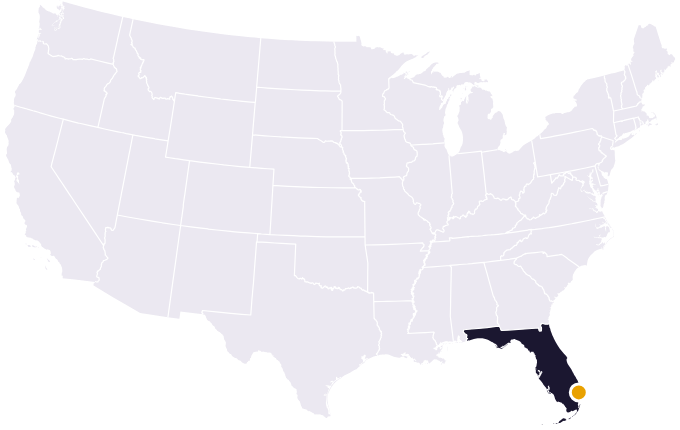
Yellow light: allowed with an owner-held permit and a city inspection
Pompano Beach requires an annual permit to run a short term rental in a residential zoning district, and it is issued only to the property owner for one specific property.[1] So your landlord has to apply, or sign a notarized affidavit that names someone to file for them.[2] The city inspects the unit before it issues the permit.[1]
Our verdict, based on the sources at the end of this guide.
Pompano Beach requires an annual permit for short term rentals of single-family homes, duplexes, triplexes and quadplexes.[1] The permit goes to the property owner, not the tenant, and costs $675 to $750 to start.[1] Inspectors from code compliance, building and fire check the unit before the city issues it.[1] The city can revoke the permit after two code violations in 90 days.[1] Condominiums are left out of the city's definition of a short term rental.[1]
Key requirements
Owner's permit
Every owner who runs a short term rental must first get a permit from the Development Services Director.[1] The permit covers one owner and one specific property, and a new owner needs a new permit.[1]
Eligible properties
The permit covers single-family homes, duplexes, triplexes and quadplexes.[1] The city's definition of a short term rental, a stay of six months or less in a calendar year, doesn't include condominiums, condo hotels, hotels, motels, timeshare properties or bed and breakfasts.[1]
Fees and renewal
The initial application fee is $675 for a single-family home or duplex and $750 for a triplex or quadplex, and renewal is $375.[1, 3] Permits run Oct 1 to Sept 30 and must be renewed before they expire.[1]
Application package
You submit a site plot plan, a floor plan, your standard rental agreement, a Broward County business tax receipt and proof of state sales tax and county tourist tax registration, plus a state DBPR lodging license if required.[1] The city's guide also lists a current city business tax receipt and a lien search done within 30 days.[3] The owner can file it, or name a representative in a notarized affidavit who is at least 18 and lives or keeps a business in Palm Beach, Broward or Miami-Dade County.[2]
State law
Florida law says a local law may not prohibit vacation rentals or regulate how long or how often they are rented, except for local laws adopted on or before June 1, 2011.[7] The state requires a vacation rental license if you rent an entire unit more than three times in a calendar year for periods of less than 30 days or 1 calendar month, whichever is less.[8] A 2026 bill that would have added water safety rules for licensed vacation rentals died in the House on Mar 13, 2026.[9]
Operational and safety standards
Inspection
Inspectors from Code Compliance, Building Inspections and the Fire Department check the unit against the city code, the Florida Building Code and the Florida Fire Prevention Code.[1] Violations must be fixed and the unit re-inspected before the city issues the permit.[1]
Occupancy and parking
Occupancy can't go above the zoning district limit, and never above two persons per bedroom.[10] Overnight, you can have no more than one car per bedroom, all in approved off-street spaces, and no commercial or recreational vehicles.[10]
24-hour contact and trash
Your 24-hour contact must be available around the clock, have authority to fix problems and be within 25 miles of the rental.[10] Provide at least one 32 gallon covered refuse container per bedroom, stored behind the front or street side building line.[10]
Ads and posting
Ads must show the state DBPR license number, the city permit number and the maximum occupancy.[10] Inside the unit, post the local contact, maximum occupancy, noise notice, parking sketch, trash days, nearest hospital and police non-emergency number, and give renters an evacuation plan.[10]
Special events
Each rental is limited to one special event per fiscal year (Oct 1 to Sept 30), and it needs a permit.[10] Outdoor musical performances are prohibited.[10]
Tax obligations
State sales tax
Florida charges 6% sales tax on renting living or sleeping accommodations for six months or less.[4] Returns and payments are due on the 1st and late after the 20th day of the month following each reporting period.[4]
County surtax
Broward County adds a 1% discretionary sales surtax.[5]
Broward tourist tax
Broward charges a tourist development tax on rentals of six months or less, made up of a 2% tax plus four additional 1% taxes, which adds up to 6%.[6] The state's rate table also lists 6% for Broward, collected by the county.[11]
Who collects
The ordinance has the person who receives the rent charge the tax, collect it from the guest and remit it.[6] The county's registration form is for owners, dealers, lessees and property managers in the transient rental business.[12] The city also asks for proof of state sales tax and county tourist tax registration with your permit application.[1]
Enforcement
Warnings and fines
A violation gets a warning notice with 30 days to comply, but inspectors don't have to give one for repeat violations, serious threats to public health, safety or welfare, irreparable violations or violations of an itinerant or transient nature.[1] The Special Magistrate can fine up to $1,000 a day per violation for a first violation, $5,000 a day for a repeat and up to $15,000 for an irreparable one.[13]
Revocation
The city can revoke a permit for false statements on the application, for an uncured failure to keep your state license or your state and Broward tax registrations, or for an uncured code failure.[1] Two or more code violations tied to the rental within 90 days, such as parking, noise or garbage, are also grounds.[1] You have 10 days to appeal in writing.[1]
After a revocation
No one may occupy the rental and no ad may run while the permit is revoked.[1] The city also won't issue or renew your city business tax receipt until the violations are fixed.[1]
Late renewal
A permit that isn't renewed on time gets a penalty of 25 percent of the renewal fee and is inactive until renewed.[1] After a year without renewal, you must apply again.[1]
Complaints and public list
The city posts a list of short term rentals. Neighbors are told to report problems to the city department that handles each type of complaint, with Code Compliance as the fallback.[14]
Bottom line for arbitrage
It works if your landlord will apply and sign. Don't start renting before the owner's permit is issued.
Step 1 is the hard part. We find landlords who already said yes →
Sources
Tell us your market. Our team calls landlords and sends you properties already approved for Airbnb.
- Landlord-approved listings
- New deals weekly
- Search any US market
More guides in this state
Browse all city guides →Rules tell you where. We find the landlord who says yes.
STR Exchange members get landlord-approved rentals, new deals every week and a team that searches their market.
- Landlord-approved listings
- New deals weekly
- Many markets